Who were these guys? A Look at Early Licensed Physicians in Mississippi

We know a good deal about the early history and development of our system for medical licensure in this country. Historian of medicine Richard Shryock and medical regulator Robert Derbyshire1 contributed short but valuable works in the 1960s. Sociologist Paul Starr addressed licensing as one part of his masterwork on the social development on the medical profession.2 Scholars like Ronald Hamowy and Samuel Baker authored oft-cited journal articles looking specifically at the legislative origins and evolution of early medical licensure3 while the historian James Mohr explored the legal basis for medical regulation.4 What all of these authors contributed were broad brush stroke portraits of our medical licensure system—narratives delivering a valuable macro-level view of the subject.

What has been less frequently presented are state-level analyses of these origin stories for medical licensure. A scholarly few exist: Clinton Sandvick for Illinois, Samuel Baker for Massachusetts. Yet there is little in the scholarly literature that takes even a cursory look at the demographic profile of early licensees in any state. To put it bluntly, we have seldom posed the question, “Who were these guys?” (And yes, I know there were women too; small in number attempting to succeed in an entrenched patriarchal landscape)

The gift of a series of registry books from the Mississippi State Board of Medical Licensure to the FSMB Historical Collection provided me with an opportunity to explore that ‘Who were they?’ question directly. The donated volumes contained thousands of individual records assembled as part of a 1930s W.P.A. project for the Mississippi Department of Health—specifically individual applications for medical licensure in that state.
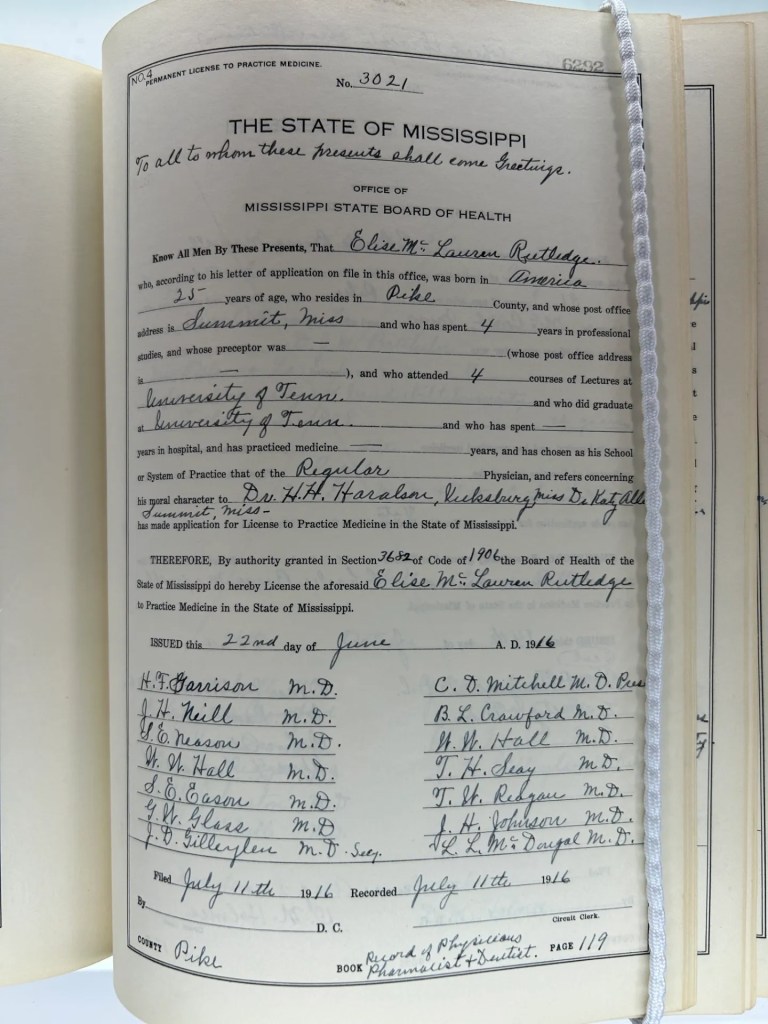
The time available to me precluded reviewing the entirety of the records contained in those volumes. Instead, I undertook a targeted, hopefully representative sampling from those volumes—approximately 472 records. What follows is a demographic summary of that sample set supplying insight into the early licensed practice of medicine in Mississippi. Who were they? Where were they educated? How much (in)formal training did they bring to their practice?

The 472 individuals were licensed over six decades (1882-1940). The majority of the records (80%) fell within the first three decades of that period. It comes as no surprise that the licensees over overwhelmingly male over this time span. Only six women were found to have been licensed in this sampling. Similarly, this sample found only four likely black physicians if we infer race from their associated medical school (Meharry-one of the historical black medical colleges).

While intra-professional strife characterized the relations between “regular” (i.e., allopathic) physicians and their “irregular” brethren for the second half of the nineteenth century, the small number of non-allopaths during this extended period (n=15) suggests these tensions may have minor irritants at best in Mississippi. The fifteen were categorized by the board as either eclectic, homeopathic, botanic or mineral physicians. Interestingly, no osteopathic physicians appeared in this data set spanning six decades.

Time period# of licenseesHolds Medical degreePreceptorship“Irregular” practitioners
1882-189017268 (39%)125 (73%)15
1891-19007948 (61%)41 (52%)0
1901-191012660 (47%)57 (45%)0
1911-19204134 (83%)21
1921-19303534 (97%)30
1931-19401916 (84%)00
     
Total 1882-1940N=472N=260 (55%)N=228 (48%)N=16 (3%)

One question peaking my curiosity involved education—what type of medical education and training did these early licensed physicians bring to the treatment of their patients in Mississippi? 

Only 55% of all the physicians in this sample reported having graduated with a medical degree. For those who did, where they attended medical school is worth sharing. Few of these physicians obtained their medical education and degree outside of the South. The medical colleges in Tulane and Memphis were the primary source institutions with 116 and 115 licensees respectively. Degree holders from schools in Louisville, Nashville and Jackson were smaller in number but still significant sources of the degreed-physicians in Mississippi.

Only 15 of these licensees presenting a medical degree obtained that credential from an institution outside of the South. Schools in Chicago, Cincinnati, New York City and Philadelphia predominated. (Note: My definition of the “South” included border states such as Missouri, Kentucky, Maryland)

If the strong southern orientation of the medical schools for these degree holding physicians didn’t surprise me, something else did: The number of individuals reporting medical education from more than one institution. More than one quarter (n=128) of the 472 physicians in the sample reported attending lectures at two or more medical colleges. While speculative, it may be surmised that repeating a set of didactic lectures at a second school was, if not common, then at least not unusual. Additionally, seeking clinical experience away from the school providing the core medical lectures seems understandable in an era when the onus for obtaining training fell more to the physician rather than their institution.
One of the more telling figures in suggesting the profoundly different educational landscape for medicine at that time involves the number of licensees presenting to the Mississippi board absent a medical degree. Less than half (46%) contained in this sample covering the period 1882-1910 possessed a medical degree.

This may seem strange to us today. However, like many states, the introduction of licensure laws in Mississippi included provision for licensing individuals who did not attend or graduate from a medical college.5 The reality is that such provisions were pragmatic in nature as state legislatures opted more often than not to grandfather in those individuals already practicing in the state who might not otherwise meet newly implemented requirements.

A total of 212 individuals reported no medical degree…and yet all but 27 of these physicians reported having attended at least one set of lectures at a medical college. Thus, licensed physicians who were wholly self-taught or trained solely via preceptor or apprentice relationships constituted only 6% of all the licensees in this sample.

The most common experience among the Mississippi licensees spanning these first three decades involved preceptorship. 59% of all the licensees during that period claimed one. Interestingly, familial connections may have played a prominent role in this as 55 of the 223 licensees did their preceptorship with a physician bearing the same last name. While some of these may have been coincidence, it seems likely that familial connection (father, brother, uncle, cousin) facilitated the training. The reported length of time under preceptorship seems not insignificant—a 3-years mean/median across the entirety of the sampling. Even if this self-reported data is inflated by half, it suggests that informal training occurred longer and more extensively than one might have thought.

One caveat to the preceptor data. This practice was common enough that it remained a standard field on the licensing application throughout the entire 1882-1940 time period. However, it was clear to me that some physicians (or the staff member filling in the form) classified the clinical portion of their medical education under the preceptor category. I excluded those instances where it seems clear this was being done.
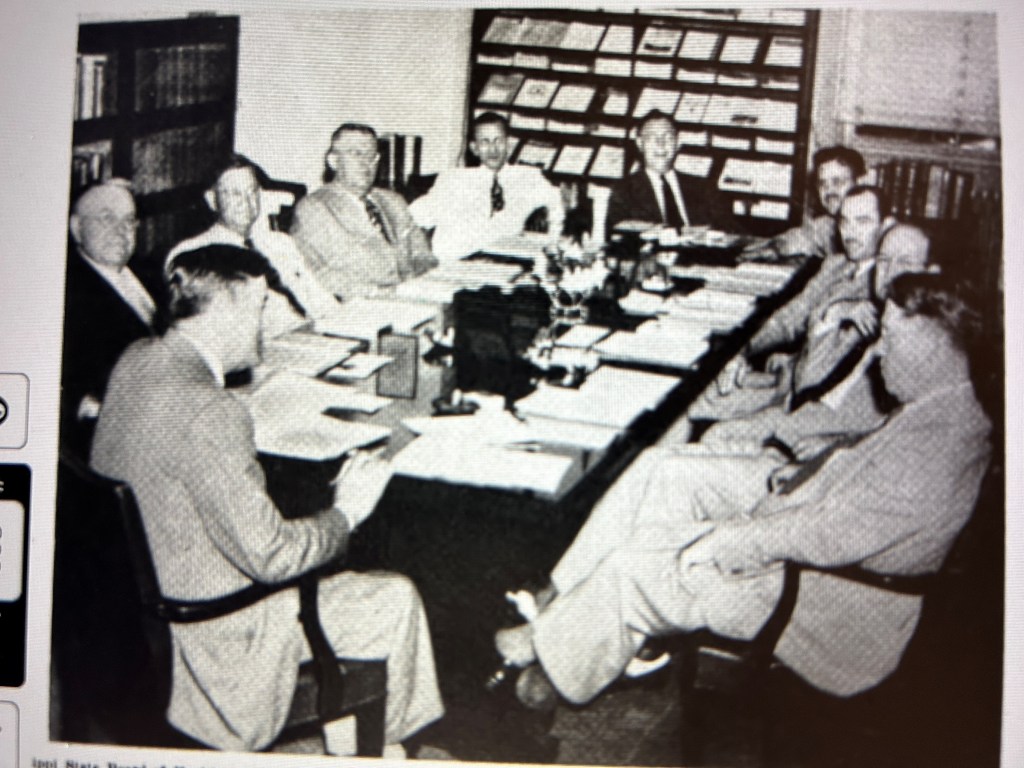
So what to make of this data? Perhaps the key word to keep in mind is dynamic. This data, while specific to a single state, reflects the evolving nature of the medical educational and regulatory systems in late nineteenth and early twentieth century America—essentially a system in flux. Educational standards were still being formulated through a de facto accreditation process via the AMA Council on Medical Education and AAMC. Legislatures were following that lead by codifying these classifications for medical schools as the basis for licensure: Graduates of Class A and B schools as eligible; Class C graduates ineligible. Mississippi required graduation from a Class A school starting in 1919.6 Legislatures enacted and medical boards operationalized licensure requirements mindful of this still evolving educational landscape as well as the presence of thousands of established practitioners whose medical careers predated these changes.

Of course, we should be cautious in drawing conclusions from what is a sample set of data. Still, the data is consistent with what we would expect during a transition era in the history of the profession and the regulatory system. Perhaps an ambitious scholar would like to visit the FSMB Historical Collection and use these records for a more systematic survey and analysis?  

The opinions expressed are those of the author and do not represent the views of the Federation of State Medical Boards.

  1. Richard Shyrock, Medical Licensing in America, 1650-1965 (Johns Hopkins, 1967); Robert Derbyshire, Medical Licensure and Discipline in the United States (Johns Hopkins, 1969)
  2. Paul Starr, The Social Transformation of American Medicine (Basic Books, 1982)
  3. Ronald Hamowy, “The Early Development of Medical Licensing Laws in the United States, 1875-1900,” Journal of Libertarian Studies, 1979; Samuel Baker, “Physician Licensure Laws in the United States, 1865-1915,” Journal of History of Medicine and Allied Sciences, 1984
  4. James Mohr, Licensed to Practice (Johns Hopkins, 2013)
  5. See Section 17 of An Act to Regulate the Practice of Medicine in the State of Mississippi (Jackson: State Printer, 1882)
  6. Mississippi Laws and Extracts of Laws Dealing with Public Health (Jackson: Mississippi State Board of Health, 1947), 104

Unexpected Encounters with History

Earlier this summer my wife and I were traveling through Colorado and spent a couple nights in Trinidad. After a nice dinner at a Mexican restaurant in their downtown, we strolled the streets, window shopping and enjoying the mild weather. We ran across a placard inside one building that gave a bit of history to that site and Trinidad’s early days.

The placard related a number of “firsts” dating to 1867, including mention of Dr. Michael Beshoar as the proprietor of the “only drug store Santa Fe to Denver.”

I was taken aback when I read the name. Michael Beshoar didn’t just ring a bell. I knew precisely who he was and why I remembered that name. It turns out that one of Trinidad’s most famous early physicians had a direct connection to America’s largest medical diploma mill. As Dr. Beshoar learned firsthand, eighteen hundred miles wasn’t far enough to distance himself from a questionable decision and even more dubious connection.

Prior to seeing Beshoar identified as a prominent early citizen of Trinidad, my knowledge of him derived from familiarity with seeing his name on the printed list of faculty for John Buchanan’s medical college in the mid-1870s. I learned a bit more about Beshoar when I discovered the Denver Public Library contained archival materials including his “papers.” From these I learned that Beshoar’s connection with the infamous diploma mill dated to 1873.

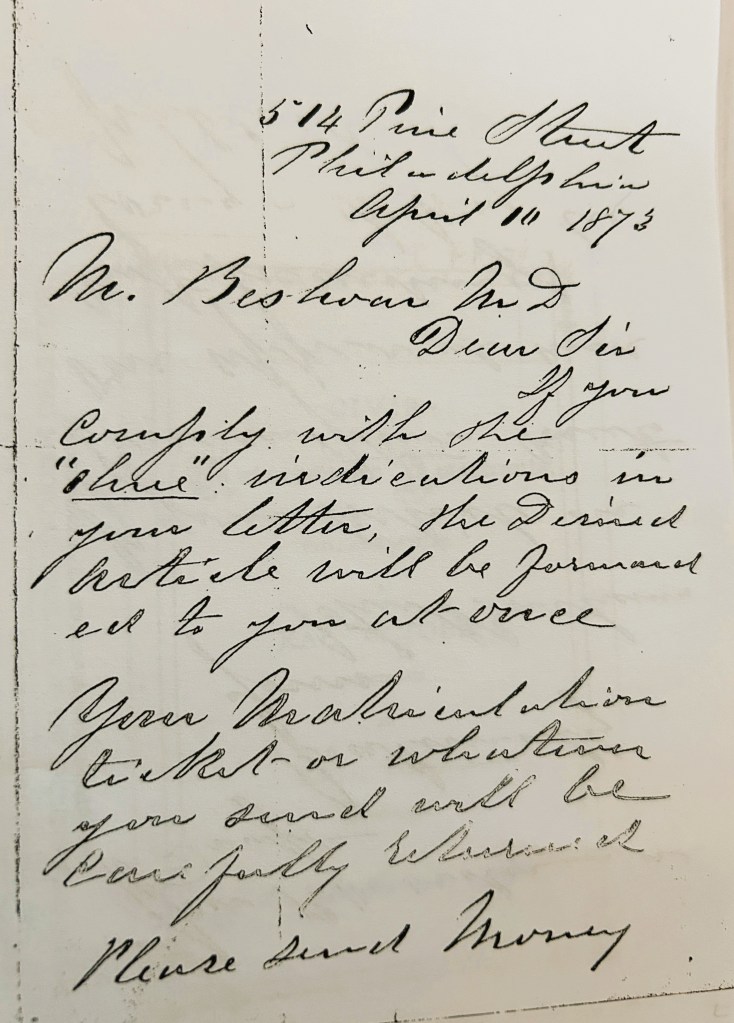
On April 10 of that year, John Buchanan responded to an inquiry from Beshoar stating:

“Dear Sir, if you comply with the [?] directions in your letter,  the desired article will be forwarded to you at once. Your  matriculation ticket or whatever you send will be carefully [?]. Please send money for P.O. order or draft.”

The indirect language and euphemism (“desired article”) were common features of John Buchanan’s operative style when dealing with prospective customers by mail. The context for this letter and later exchanges between the two men make it clear that Beshoar had expressed interest in purchasing a diploma from one of Buchanan’s legally chartered schools: the Eclectic Medical College (EMC) or the American University of Philadelphia.

Another letter from 1879 included an interesting pledge from Buchanan. He assured Beshoar that, “we shall take care of your interests if there is any inquiries.” Whether this was specific to securing students for his fall 1879 classes at the EMC or if this alluded to the press inquiries growing more frequent concerning the nature of Buchanan’s operations is unclear. One suspects that Buchanan stood behind both.

When I finished my book on the subject (Diploma Mill), my view of Dr. Michael Beshoar was uncomplicated. He was simply one of the rogues unmasked by the Philadelphia Record’s crusading editor, John Norris after authorities’ arrest and search of Buchanan’s offices at 514 Pine Street. But that placard in Trinidad gave me pause. What did I really know about Dr. Beshoar? Was he just another of Buchanan’s scoundrels? Or was there more to his story?

I decided to look more closely. As you’ll see, the picture becomes more nuanced and less clear. (Note: The same is true for another EMC “graduate” that I wrote about in 2019)

Michael Beshoar was born in 1833 and later graduated from the University of Michigan’s medical college in 1853. Beshoar relocated to Arkansas where he established deep roots: he married, established a medical practice and served in the state legislature. When the Civil War broke out, he served as a medical officer for the Confederacy. Captured in 1863, he began treating Union troops and ultimately served the U.S. Army at Fort Kearney in Nebraska Territory.

A flamboyant frontier persona

By 1867, he drifted into Colorado, first Pueblo and then Trinidad. In the latter town, his wide interests and boundless energy saw him practicing medicine, operating a drug store, creating his own patent medicines; and later opening a newspaper, engaging in land speculation, serving on a vigilance committee, pursuing local and state political offices and much more. Dr. Michael Beshoar’s boundless energy and entrepreneurial interests touched just about everything and everyone in the Trinidad region.

All of which begs the question: Why did Michael Beshoar get mixed up with America’s most notorious medical diploma mill? 

To understand this, we need to go back to Beshoar’s days in Arkansas. Like so many Southerners, the Civil War ruined him financially. In an 1879 letter, he claimed to have come out of the war with “$1.20 suit of summer clothes” and little else. Thousands of acres that he had procured earlier in northern Arkansas were lost to back taxes. His dreams (“I was sure to being a millionaire in a few years”) were dashed.

Still, ambition never seemed to wane in Beshoar. While he studied and practiced medicine, Beshoar appeared to see himself as much more than just a physician. Ambition is the key to understanding Dr. Michael Beshoar and ultimately his interactions with Dr. John Buchanan.

Let’s go back to that 1873 correspondence with John Buchanan. At that time, medicine was effectively an unregulated field in this country. Only North Carolina and Texas had laws in place controlling medical practice. Even then I doubt whether much, if any, enforcement of these laws took place.

Most Americans’ experience of health care involved what we would categorize today as folk medicine, i.e., botanical remedies delivered in the home by family, friend or a trusted neighbor. The “doctor” called in to render aid was more often a local healer whose skills (real or perceived) were valued in their own right. Probably only a minority of Americans received treatment at the hands of a doctor as defined by someone possessing a medical degree or diploma.

Recall that Beshoar received a medical diploma from Michigan. So why would he have been seeking one of Buchanan’s diplomas? Initially, I thought the likely explanation was simply that Beshoar no longer had the sheepskin credential in his possession after his many moves. That turned out not to be the case as newspapers covered Beshoar’s attendance at a 1903 reunion in Ann Arbor where he produced the original diploma and seal issued to him half a century earlier.

So if it wasn’t a case of replacing a lost diploma, why would have wanted one from Buchanan? The answer may be as simple as this: While a medical degree wasn’t necessary to practice in Colorado, it was a great distinguisher that could only enhance Beshoar’s standing in the community. So, if he was going to have a diploma, it couldn’t hurt to have a degree from a school in Philadelphia, the unchallenged epicenter of American medicine. Beshoar’s would have been an ad eundem degree, i.e. one conferred in addition to an earlier degree. This is entirely speculative on my part but wholly plausible. This was a fairly common practice among 19th century colleges and universities.

Beshoar and Buchanan engaged in periodic correspondence in the 1870s. In his February 1875 letter to Beshoar, Buchanan wrote, “Your letter and proposition accepted….” Beshoar had apparently requested appointment to the EMC faculty and though the appointment ultimately was just titular (Beshoar’s name on the faculty list), their correspondence makes clear that Buchanan actually expected Beshoar to join him in Philadelphia to teach the fall 1875 session. Their correspondence continued into 1878 with Buchanan still hoping for Beshoar’s presence on-site and asking for a photograph so that all faculty could be represented in their advertising.

Ultimately, Beshoar did receive a Buchanan diploma and had his name on the faculty list presented in the EMC’s journal and the school prospectus. While these items might have been showcased in Beshoar’s office, they later proved problematic for him.

In the summer of 1880, John Buchanan was arrested and his offices searched. His subsequent faked suicide and flight from justice made front page news across the country. The Philadelphia Record and other newspapers printed various materials captured in the police raid, including exhaustive lists of the many recipients of Buchanan diplomas. Nestled among the the names: Michael Beshoar of Trinidad, Colorado

In an undated letter, the president of the Colorado State Medical Society demanded that Beshoar appear to answer multiple charges including questionable advertising, misrepresentations about his relationship to the ‘Rocky Mountain Medical Association’ and his status as “Emeritus Professor of the Practice of Medicine in the American University of Philadelphia—a notorious mill concern.”

Since the Colorado State Board of Medical Examiners wasn’t established until 1881 there were no licensing repercussions for Beshoar. And at the end of the day, membership in the state medical society wasn’t necessary to practice medicine.

So where did this leave Beshoar? Perhaps slightly embarrassed and the subject of snide comments from locals who heard the rumors coming from Beshoar’s medical brethren but probably not much more.

His interactions with Buchanan and his dubious medical colleges carried little risk for most of the 1870s. Beshoar sought a credential and a little gravitas through a titular faculty appointment that he likely saw as just a means to an end—bolstering his reputation and his medical practice in the community. These were precisely the moves of an energetic entrepreneur. Unfortunately for him, changing times brought legislation regulating the practice of medicine to every state and territory. The go-get’em spirit that rewarded bold, opportunistic types like Dr. Michael Beshoar looked a lot different by 1880 when the full nature of Buchanan’s diploma mill became known. Beshoar’s wide interests and influence in southern Colorado’s medical, political and newspaper communities made a fair number of rivals and outright enemies. His connection to Buchanan and the EMC provided easier fodder for critics looking to smear Beshoar’s reputation.

I have yet to run into anything in the historical record for Beshoar that suggests this blemish on his career made any lasting impression. While his grandson’s book, Hippocrates in a Red Vest, addressed the issue directly, his review of the evidence strongly suggests the links to Buchanan were a minor irritant in an otherwise remarkably diverse and successful career. Most of the sources and stories characterize him as a bit of free-spirited pioneer. Fair enough. Sleep well, Dr. Beshoar.

Dr. Beshoar in center right light colored top hat. Standing before one of the newspapers he founded.

The opinions expressed are those of the author and do not represent the views of the Federation of State Medical Boards.

Sources:

Michael Beshoar Papers, Box 7, Folder FF19

Barron Beshoar, Hippocrates in a Red Vest

Carl Bartecchi, “Practicing Medicine in the Wild West.” Access August 22, 2025 at https://www.michiganmedicine.org/medicine-michigan/practicing-medicine-wild-west

Nancy Kristofferson, “Michael Beshoar: Doctor and Developer,” World Journal. Huerfano, Colorado. November 20, 1914. Accessed August 22, 2025 at https://worldjournalnewspaper.com/michael-beshoar-doctor-and-developer/