My last blog post shared stories of early instances of cheating on the licensing exams administered by state medical boards. It might be comforting to view such incidents through the gauzy lens of a long-ago yesterday—as problems confined to the dust bin of history. Uh…not quite.
Even today there are young medical students and physicians reckless enough (or sufficiently desperate) to endanger their career with risky, unethical behaviors related to the United States Medical Licensing Examination (USMLE).
First, let me say that these episodes are outliers. The overwhelming majority of USMLE test administrations (99.9%) take place with no questionable conduct by examinees. At the same time, it’s important not to be lulled into a false sense of security—just because something seldom happens doesn’t mean its potential and impact are somehow lessened.
So what am I talking about specifically? Let me share a few examples of scenarios and cases I’ve seen in more than twenty-two years working with the exam.
Security violations
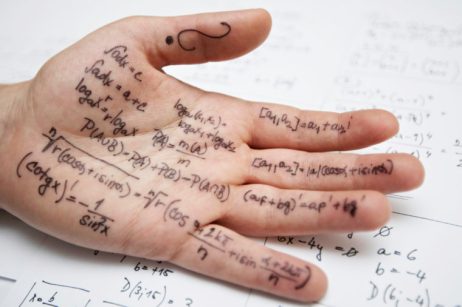
This category covers a wide range of activities, including standard fare that might immediately come to mind—examinees trying to bring notes or other materials into the exam; as well as the reverse, trying to take test information out of the exam.

Hand of student with cheat sheet for math exam – selective focus
One examinee was caught with a textbook shoved into the waist of their sweatpants! (How this person thought they would use it with human and video proctoring is still a mystery to me!)
The rise of “smart” devices pose a unique risk. Yet some examinees struggle to understand why their smart phone has no place in the exam room.
Creating a new identity
Among the community of international medical students and graduates there are instances in which a poor start on the exam (e.g., several failed attempts on a Step) leads an individual to try to wipe the slate clean. Because naming practices have features unique to cultures and regions, some individuals attempt to apply using a slight variant on their name and/or biographical information.
Colleagues at the Educational Commission for Foreign Medical Graduates have become extremely adept at spotting these tactics.
Falsified documents
Examinees have been known to alter documents to their advantage. This involves a degree of premeditation and calculation that is disturbing. For example, the USMLE transcript is produced on a specific paper incorporating multiple security features. Altering such a document is impossible without leaving clear signs of tampering. One examinee solution was to attempt to get their hands on the actual security paper! I can’t offer details but let’s just say this bizarre attempt at subversion didn’t get very far.
The weak point in any security system is most often the human element. The same holds true with falsified documents. Providing USMLE transcripts through secure portals to state medical boards or to residency programs through ERAS eliminates the possibility for falsified documents when they are sent directly to the end user—yet this is dependent upon these same users of the document not accepting an unofficial and/or xerox copies of transcripts or score reports. This is where problems arise.
 In my experience, the ability of an unscrupulous individual to get away with a falsified document is directly a function of their ability to play upon an existing relationship with a staff member or faculty at their school or program. I’ve seen this dynamic play out a number of times as the person asking the examinee for evidence of having tested or passed simply can’t believe that the person standing in front of them would ever do something as unprofessional as falsifying their exam record. In fact, they might even feel awkward or embarrassed about questioning a proffered photocopy of a score report or transcript by a student or resident that they have known perhaps for several years.
Sure, on one level the faculty/staff understand people have been known to alter documents but it seems inconceivable to them that such a thing could or would happen at their institution. “I know David. He would never do something like that.” To reiterate, in my experience, these are precisely the scenarios by which the desperate student/resident attempts to either buy additional time or get out of a troublesome situation relative to the exam. I remember sharing an anecdote of such a case with one program director who seemed genuinely stunned that such things ever happened…and yet I’ve seen cases like this involving Step 3 and residency training in particular.
Sociopathic behavior
Okay, I’m neither a physician nor a clinical psychologist and yet what I have observed on occasion when individuals charged with irregular behavior appear before the USMLE Committee on Individualized Review is almost frightening. I have observed individuals, despite a mountain of physical evidence demonstrating their guilt beyond a reasonable doubt, protest their innocence and feign ignorance of how their signature ended up on a document or how an altered photocopy of a score report made its way to staff at their program.
One thing is certain—the courtroom confession seen on Matlock and Perry Mason is a cheap literary device with virtually no basis in reality. I have only once seen an individual crumble under intense, pointed questioning and ultimately confess to irregular behavior.
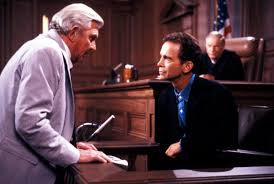
Instead, the norm for those who come in protesting innocence is to double down, conceding nothing and offering explanations involving disgruntled ex-girlfriends, inappropriately helpful family members or an outright “nemesis” bent on ruining them. (Don’t laugh—it has happened)
I know some of you are reading this thinking, “Come on, nobody does that, right?” Wrong. My colleagues and I have often said to each other, “You couldn’t make this stuff up because nobody would believe it.” And yet it’s true.
It is precisely this doubling down behavior rather than expression of remorse that is troubling. Don’t get me wrong. Remember, there are relatively few cases of alleged irregular behavior associated with the exam…and the behavior I just described is a small subset of that. Yet, I’ve seen examinees given every opportunity by the committee to “come clean” with the underlying message that a remorseful admission of guilt would be viewed more favorably…and still the individual persists against the mountain of evidence and with explanations almost contrary to the laws of the physical universe in proclaiming innocence. It is these instances that are truly frightening—of an individual’s ability to present lies and counter arguments beyond all plausible believeability. These are also the cases that those of us in attendance find most troubling.
The traditional professions—clergy, law, medicine—are founded upon a commitment of service to a greater good for the benefit of society; and with a commensurate goal of enforcing high ethical standards for professional conduct. My point in sharing these historical and more recent incidents around the licensing examination is simply to remind us all: human nature does not change based upon the mere bestowal of a credential.
Note: The views expressed are those of the author and do not reflect those of the Federation of State Medical Boards or the United States Medical Licensing Examination (USMLE) program.




 My professional activities bring me into regular contact with current and former members of state medical boards throughout the United States. One of the conversational threads that often arises involves reappointment to the board. Often, I’ve heard phrases like, “I’ve termed out but the governor hasn’t appointed anyone yet to take my place” or “We have a Republican governor now and I was appointed by a Democrat so I’ll have to wait and see if I’m reappointed.”
 Even one who enjoyed such extreme longevity on his medical board (Robert Derbyshire) acknowledged the trade off this entailed. Yes, the veteran of 20 years on the medical boards may have become expert in disciplinary hearings but, Derby wondered, at what cost in terms of other/new ideas?
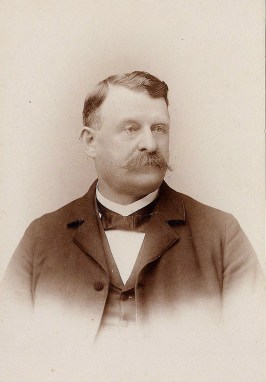 He opened a pharmacy in 1875 in Mansfield, Massachusetts and appears to have combined a medical/pharmacy practice. Massachusetts proved rather late in adopting medical legislation. It wasn’t until 1894 that Dr. Wilson had to apply for a medical license with the Massachusetts Board of Medical Registration.

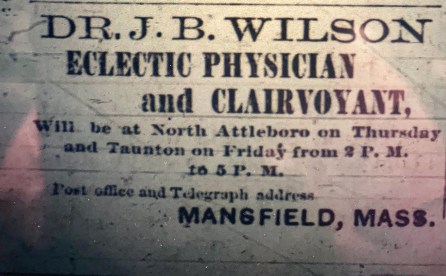 He was apparently a prudent business man too. Eventually, he dropped the clairvoyant from his ads as the early enthusiasm for medical hypnosis waned. Later, he dropped eclectic from his physician title as ‘regular’ medicine began to absorb the homeopaths and eclectics who once saw themselves as practitioners offering patients an alternative to conventional medical practice.



 But for all the supposed familiarity with the report by those who love to reference it, one portion has been largely forgotten and seldom cited—chapter 11 dealing with state medical boards. I re-read this chapter recently. What struck me most in revisiting the text was Flexner’s juxtaposition of praise and criticism of state medical boards. I found myself momentarily flashing back to my 10th grade English class, Julius Caesar and Marc Anthony’s funeral oration: “I come not to praise Caesar but to bury him.”
 Flexner identified three weapons at the disposal of state medical boards—all of which derived from their statutory authority bestowing varying degrees of oversight/influence on education within their state. These powers included…
 Recently, I re-read her commentary; several things stood out to me. One was the strong sense that a woman running for elective office in the 1980s—even within a national association rather than political office—was not a matter to be taken lightly as missteps by a candidate served as potential fodder for the larger narrative of critics. Thus, in mulling over whether to run for the office, Behrens consulted two influential women in medicine at that time: Dr. Edithe Levit, President of the National Board of Medical Examiners and Dr. Nancy Dickey, member of the AMA board of trustees. Their advice boiled down to what you see as the title for this piece.
 The 1985 FSMB Handbook listed 66 state medical boards with a total of 602 individuals serving throughout the country; only 99 (16%) were women. In fact, most of the women serving on state medical boards were non-physicians in public member or ancillary health profession roles. Dr. Behrens was one of only 40 female physicians serving on medical boards in 1985—6.6% of the total state board membership.

 The armchair historian